Friday, December 23, 2011

Author Molly Noble Bull: Toppling A Learning Disability And Shining Bright

Everyone's Story's guest this week is author Molly Noble Bull, a woman who has redefined the term perseverance. Molly is a Texan, hailing from a family of true cowboys. Perhaps that is where she inherited her grit to overcome a learning disability that usually brings hardships to so many. Or, perhaps she leaned at an early age to hold God's hand when facing troubles. Come visit with Molly as she talks about her new non-fiction release The OVERCOMERS: CHRISTIAN AUTHORS WHO CONQUERED LEARNING DISABILITIES that she had co-authored with several authors.


Want a great read? Molly is graciously offering one copy of her prize-winning historical novel SANCTUARY that is set in 1740 France. Just leave a comment (and your email address within the comment for contact purposes only) and one person will be randomly chosen to receive this novel. And of course, it would be greatly appreciated if you became a Follower of this blog.
First, a few questions for Molly:

I can definitely relate to that awful childhood syndrome of being "The Last To Be Chosen." Although I loved to dance, bike, and walked (for miles) I never played team sports, nor did anyone want me. One rainy day in gym class we played softball (it was a huge gym). Of course I was the last one to be picked when it came to choosing teams. . . but enjoyed a great comeback when I hit a home run! Molly, do you have an anecdote to share with us?


Yes. In about the fifth grade, I was a shortstop in a game of softball. I never expected to do much, but when the other side hit the ball, I caught it. Nobody was more surprised than I was. I think maybe I dropped it after it fell into my hands, but I still felt good about actually catching a ball for probably the first time in my life. 

How have you taught your children and grandkids that everyone is indeed different and that often our differences are a blessing, even if we don't realize it at first?  

I never called my children hurtful names as some parents do. As you said, children are a blessing from God. 

Why Molly Couldn't 
Read, Spell, or Do Story Problems in Math by Molly Noble Bull
 
I talked earlier than some children. My parents thought I was some kind of genius. In fact, I have always communicated well verbally. Papa and Mama expected me to do well in school. Imagine their surprise and disappointment when I didn’t.  

Yes, I am a published novelist. I am also married, the mother of three grown sons and a grandmother. 

My newest book (non-fiction) is just out and titled The Overcomers: Christian Authors Who Conquered Learning Disabilities by Margaret Daley, Ginny Aiken, Jane Myers Perrine, Ruth Scofield and me, Molly Noble Bull. Yet I make spelling and punctuation mistakes galore (even today) and for a good reason. 


I am dyslexic, and dyslexia never goes away. You just learn to go around it. Cope. I didn't learn to read until I was in the fourth grade. I wasn't good in sports, and spelling skills and seeing my own mistakes were beyond me. Yet today I write books that other people read.

Maybe you or somebody you know has a learning disability. If so, you are aware of the strain this person is under daily. Hurtful names like stupid and retard are not rare. For a while, I was convinced that they were right—that I was retarded. 

My father and my maternal grandfather were ranch managers. Cowboys. I spent part of my growing up years on a sixty thousand acre cattle ranch in South Texas. Below is a photo of me at the age of twelve on the Santa Rosa Ranch in Kenedy County, Texas. I’m the little girl on the left.


My mother home-schooled me on the ranch during part of my first grade year. Then we moved to Corpus Christi, and I attended what was left of that year as well as second and third grade in what might be called a progressive public school that never gave letter grades. I got straight S’s—meaning satisfactory. My parents thought I was doing well until we moved to another town, and I was forced to begin my fourth grade year at a traditional public school.


The teacher divided the children into three reading groups—the Bluebirds, the Redbirds, and the Yellowbirds. Four of us didn’t fit into any of these groups, and we weren’t given a group name. We met at a table in the hallway outside the classroom, and I guess we were the buzzards. I eventually graduated from college and so did the other girl. But I think at least one of the two boys might have been institutionalized. Let’s call him Johnny. He was almost fifteen and in the fourth grade.
  
Johnny got to draw all day while the rest of us did school work. Since I liked to draw, too, I got to thinking. We are both buzzards. So why can’t I draw pictures? I went up to the teacher desk and said something like, “Johnny gets to draw. May I draw, too?”

And she said, “No, Molly. You have to do your work.” 

At once I realized that maybe I wasn’t retarded after all. 

I was always the last child to be chosen in sports and the first child to sit down during a spelling Bee. I would study my list of spelling words diligently every night for an entire week. Still, the best I could hope for on the Friday test was a C or C-. The letter grade of D was not unusual. 

But through all this, I learned to study until my head felt as if it was about to pop open like an overripe watermelon. I thought all the kids studied as hard as I did. Nobody knew much about dyslexia in those days. 
 
Some children dislike the dumbest kid in school, and in my mind, that was me. But I learned to use my imagination and communication skills and became the class clown. Everybody likes the class clown because he or she is amusing and non-threatening.  
My sense of humor was the tool that got me through high school, and I even managed to acquire some really good friends along the way. My imagination also attracted English teachers who stated that I was talented. Nevertheless, I was a poor student.

One English teacher in high school gave me a B on every essay I wrote. She would write at the top of the page —A for content—C for spelling and punctuation—equals B. Her simple act of kindness and encouragement kept me pressing on.

I think of myself as living on the other side of the mirror. What is right to you is left to me, etc. Can you spell klutzy? Though I am a fair to middling speaker, I hesitate to speak in front of a group because I might trip walking on stage or knock over the podium.  
These truths were still my secret. But after Charlie and I married, I had to tell him I was dyslexic. He would notice my rather strange behavior whether I mentioned it or not. Yet he hardly ever complained in all the years we’ve been married. Instead, he’s learned to ”cope” as well. 

When we leave a mall or a movie theater and I want to go left when the car is right, Charlie gently grabs my arm and says, “Not that way, Molly. This way.”  

The Lord also gently reminds me to go in the right direction. He pointed to the saving Grace of Jesus Christ, and I will be eternally grateful. 

I learned to read, and I can spell well enough to get by. Yet even today, I refuse to read aloud. I don’t even read my own books aloud in front of a group. When I do, all the old hurt and trembling returns like a flood. Still, it is my prayer that this article as well as The Overcomers: Christian Authors Who Conquered Learning Disabilities will encourage others and give hope to many.  

May the Lord, Jesus Christ, bless you and keep you—every day of your lives. 

Author Bio:
Molly Noble Bull is a native Texan and a published novelist. Her Christian novels have been published by Zondervan, The book division of Guideposts, and Love Inspired/Steeple Hill. 
Tsaba House published Sanctuary, and that historical novel won the 2008 Gayle Wilson Award of Excellence in the Inspirational category for published novelists. Sanctuary also tied for first place in the 2008 Winter Rose contest for published authors in the inspirational category. However, Tsaba House is no longer in business. 
To learn more about Molly, her writing and her Christian walk, please visit her website. www.mollynoblebull.com  And her blog, Writers Rest. http://writersrest.blogspot.com  

      To order THE OVERCOMERS: CHRISTIAN AUTHORS WHO CONQUERED LEARNING DISABILITIES:

Have you overcome a learning disability? In what ways have you found the strength to push forward despite the obstacles? Molly would enjoy hearing from you. Please leave a comment.


Friday, December 16, 2011

Eric Maywar--The Makings Of A Successful Independent Book Store

Eric Maywar owns Classic Books in Trenton, New Jersey. What caught my attention about Eric and his store is that not only is it successful but that Eric gets his customer, his community, and the love of a good story. Everyone's Story invited several authors and readers to ask Eric questions. Please join Eric as he replies. If you have questions that you would also like to ask, send a comment. Eric will enjoy hearing from you this week.


From Donna: How one would go about setting up a book signing with a storeowner? Do small independent bookstores sell e-books and do you offer book signings?

At our store (Classics in Trenton NJ, www.classicsusedbooks.com) an author just has to drop in and have themselves put on the calendar. 

Our customers can order eBooks through our website and we do signings and discussions for eBook authors.

From Christine: Do you ever stock books by smaller publishers when the book is receiving rave reviews and won awards? 

We’re a used bookstore, so we don’t purchase books. We are proud to feature a section of the new books of local authors who have provided their books for consignment sales. Many of them are self-published or published by smaller publishers.

From Diana:
What do you think the most challenging aspect today for an independent bookstore owner?

I think this is a good time to be an independent. While e-Books battle the chain stores, the independent customer is staying faithful to the independent store. In addition, I am getting former Borders customers who aren’t yet ready for an e-Reader.

What can authors do to help your sales?

I have had authors post links to my website from their website and leverage their book-signings to get their friends and family to come and support them.  For the most part, though, I see it my responsibility to help their sales!

What type of promotion items would you like to receive from authors?

Fliers, bag stuffers and bookmarks before an event are good promotional tools.

Where do you see the book market in the future? What do independent booksellers need to do/be aware of to ensure their presence is a driving force in today's ever-changing market?

Booksellers need to adapt to changes in the marketplace.  Used bookstores that were slow to use the Internet for sales and pricing fell. Chain booksellers who developed their own e-Reader (Nook) were in a better position than those who did not.

At the same time, play to your strengths. The independents beat chains and Internet sales with good customer service, a sense of place, easy browsability, and community involvement. Maximize these areas and remind people why independents are not going anywhere.

What's a really fun memory you have during an author event at your bookstore?

Dodge Foundation poet Doc Long brought a jazz trio with him for his poetry reading. That was cool!

What author really touches you emotionally?

I am never prepared for the emotionality of Ursula Le Guin’s short story “Guillam’s Harp,” even though I have read it many times.

What's one thing you'd like to do at your bookstore you haven't done?

That’s a stumper. Everything I’ve wanted to do I’ve made it happen: 


Jazz band in the Science Fiction section?  Done. 
    Rock band in the Mystery section?  Done.     (http://www.facebook.com/video/video.php?v=10150267908485169&comments). 
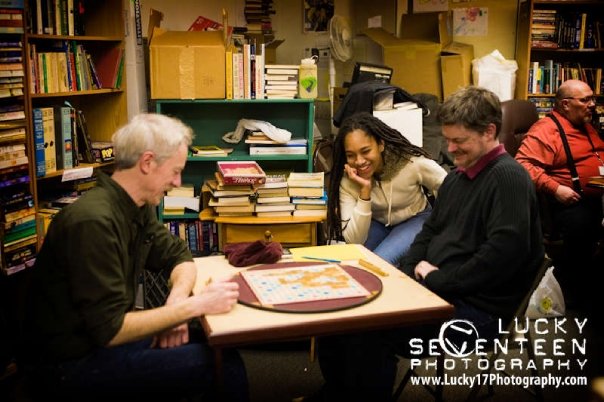
    Run a games night, because I am a games addict?  Done.
    Make a customer laugh so hard she became incoherent?  Done.  (http://www.youtube.com/watch?v=vPYZoxTK_wc)
    Raise thousands of books for kids in our struggling school system?  Done.  (http://www.classicsusedbooks.com/?page_id=13)
     Foster a community that responds to civic problems?  Done.  (http://www.classicsusedbooks.com/?page_id=65)


From Mary: 
Romance and women’s fiction has dominated the consumer market for many years. Does your store carry this genre?

Yes. We try to carry something for everybody.

Do you personally have an e-reader? Why or why not?

I do not. I like the physicality of books, the weight of them in my hand, the smell of paper. I like seeing them in bookshelves like old friends. 

In what direction do you see the relationship between e-books and print books going?

E-Books are going to forever change publishing. Print runs will dramatically shrink, but not disappear. There will always be people who want bound books. (Here’s a list of the types: http://www.classicsusedbooks.com/?p=474.)

If you have book signings, how do you set them up? Is the author at the front or back of the store? How do you advertise the author before and during the event?

The author chooses if they want to be in the presentation area in mystery, in the back in Science Fiction, at the front near the rare books section or, in nice weather, out front on the sidewalk.

We have a 700 person emailing list of qualified book lovers we email book-signing information. We do FaceBook. We send local media calendars the event information.  We contact other local promoters with overlapping interest (kids event people promote our kids books; food blogs promote our cookbooks, etc).


From Everyone's Story:
Please tell us about The Books At Home Program and Social Capital.

The Books at Home Program provides free books for kids in Trenton’s struggling school district. We hand out between 2000 and 4000 books a year through schools, community groups, the police and churches.

Social capital is a measure of the connections between members of a community. It is a measure not of just do you know your neighbors, but do you hang out with them. Do you bowl alone, or do you bowl in a league? It is the community equivalent of business networking events. Business people understand the power of networking–community people need to harness the same power.

Social capital is not just important in a touchy feely kumbaya way–fostering social capital produces tangible results. In communities where social capital is high, kids do better in school, more people volunteer, more people vote and other wise care about their city and there is less crime. By hanging out in casual settings (not just at rallies, for example, but at a regular spades game), people increase their networks and when a problem arises, whether it is personal or community-wide, solutions are easier because there are more people to help solve it. The more diverse the group (by religion, by race, by age, by socio-economic class) the better, as it more dramatically expands the resources of the group.

For example, Classics Books has a Scrabble Club on Warren Street in Trenton. In 2009, 138 people played there, but there are 20-30 regulars. When one of the regulars was unemployed, another one of the other regulars was able to get her a job at his company. This happened twice. When the mural on Warren Street was vandalized, the club took up a collection. Several of the members noticed the need for a Trenton-focused literary magazine, and the Trenton Review was born. One of the members of the club starting a knit and stitch group at Classics, which in turn knitted and donated skullcaps to the troops in Afghanistan. Whether personal or national, this group is able to pool their resources to address problems.

Tell us about yourself, and how you came to establish such an unusual but necessary book Mecca in an inner city.

I am sure it was my destiny to start a bookstore wherever I was. I am from Michigan, but my wife was from Trenton NJ, so that’s where I ended up.

Trenton is a great place for a bookstore. My customers come from the 85,000 residents in this 7 square mile city, from the 20,000 state workers who work downtown and from Scrabble players from around the state.

The fondest memory I have of my mother is when she made a pleasant sensation in front of the librarians when I received my very first library card. Like her, I was always an avid reader. I was also fortunate enough to have my aunt (my father’s sister) entertain my brother and I with wonderful oral stories. In short, story—both in written word and verbally told—shaped my young life and in many ways probably kept my sanity intact. Has your love of books started in childhood? Do you see parents spending more or less time sharing the love of books with children?

Oh yes! My parents were avid readers and without a doubt passed that along. The much anticipated yearly trip growing up in Michigan was always to Ann Arbor which had 25 independent bookstores in a square mile. While my parents went to the original Borders Books, my brother and I bounced from one used bookstore to another.

I see lots of parents coming into the bookstore with their children. I don’t think that that is dying out anytime soon!

Are you an author, reader, agent, or editor who has a question for Eric? Send a comment to Everyone's Story. He looks forward to hearing from you.

Links for Eric and Classic Books:


Friday, December 9, 2011

Author Anna Patricio--Writer & Lover of The Ancient Biblical Days

Like Joseph from the Old Testament days, I've had dreams come true (sorry Jeffery about that busted appendix back in 6th grade), family members come and go (by choice), and have been both envied and ridiculed by my spirit of hope and perseverance. I think that's why I've always related to Joseph. When Anna, from Australia, queried me about possibly doing a blog segment on Joseph I couldn't type yes fast enough.
Anna's debut novel, ASENATH, is the story about Joseph and his wife. This week she shares with Everyone's Story about her love for Joseph as well as dynamic photos of her trip to Egypt. 
Do you enjoy the story of Joseph? Please visit with Anna and tell her why. She'd love to hear from you.
First, 3 Questions for Anna:

Meaning to viewing this positively rather than negatively: When you go to your glory in heaven and are able to have countless hours of conversation around a dinner table or long walks with your eternal companions (please indulge the fantasy), Joseph being one, what top three questions would you like to ask him?


Oh boy, what a fun question this is! Me, meeting JOSEPH......*calms down* OK, OK... though I have like a million questions... they would be:

a) How did you retain your faith in God despite first being sold into slavery, and then imprisoned for a crime you didn't commit? That must have been extremely difficult to do.
b) So during which Pharaoh's reign did you really live in? There have been numerous debates: some think you lived during the Hyksos invasion (and served under the Hyksos Pharaoh), some think you served
Akhenaton, the monotheistic Pharaoh, some even say you were before the Hyksos invasion....
c) And lastly, being the author of 'Asenath' - how accurate orinaccurate is my portrayal of your wife?

And a bonus, if I may: how did the coat of many colours look like, exactly? I really wanna know!

What has your research on ancient civilization taught your about the present day world?


Well, at the risk of sounding cliche: that the ancient people were no different from us today. It's true!

Romantic love, for instance, has withstood the test of time. You hear about kings building monuments for the wives they loved so much, such as Ramses building the temple of Abu Simbel for Nefertari; the Indian
king building the Taj Mahal for his wife; King Mausolus building the mausoleum for his beloved.

Family life as well has been the same as it has for many centuries, with all its ups and downs - as we could see in the family of Joseph, for instance!


Even in everyday situations: I remember hearing about this place in Egypt called the Workmen's Village in Deir el-Medina. The workers in that place laboured on the tombs of the Pharaohs. And like many workers today, not everyone wanted to go to work. There have been found the remains of the ancient equivalent of excuse slips: "I can't go to work today because I'm sick. I can't go to work because I have a hangover." Really amusing!

And being a dog lover, I was pleased to learn that fondness for pets has existed since the ancient times. There are many portrayals of doting owners with their furbabies - on tomb paintings, statues, etc. Way to go!

If there were such a thing as time-travel, what time periods other than the ancient biblical days would you like to visit? Would you like to peek into the future?

Hmm.... maybe the Renaissance, when there was a rebirth of interest in the arts. The medieval times, I hear, were rather dark. Everything was all about the church, the Pope etc. So yes, the Renaissance would have been more my type of era.

The future would be interesting, though I am more into eras of the past. But sure, why not? Although I don't think my eyes could take all the high-tech radiation of inventions such as ebooks and stuff. For all you know, everything then will be e-something! Just the thought of it makes my eyes hurt!

NOT YOUR AVERAGE JOE by Anna Patricio
Anna at Mount Sinai
I think that if some dramatic events in my life had not happened, I would not have written my novel Asenath. If what happened didn’t happen, I would not have been spurred to explore the Joseph account so intensively and thus grow intrigued about his little-known wife. I daresay that I might not have even become a novelist period, because I never really wrote before Asenath.

But back to how my Joseph interest began.

Though I had known about Joseph all my life, what with having attended Sunday School and all, it was only later on that I really got to know him. I was 17, making the transition from the school I had known all my life to the unfamiliar and rather frightening world of university. Later on though, I would like university even far better than my former school, as it afforded me freedom I never knew until then. But in the beginning, it was really overwhelming. 

I had a teacher who intimidated us from the very first meeting. He often said, "I don't like giving easy exams. I like difficult ones. After all, wouldn't it be an insult to your intelligence if I gave you an easy exam?" Then he added all these implications about how we would flunk and such. Thus, every time his class would approach, my stomach would hurt.

As if that wasn't stressful enough, my little sister was going to have surgery for scoliosis. This would shock and stress anyone but for me, it was rather apocalyptic for until then, I had thought my family to have healthy genes, let alone be free of anything like scoliosis. So the news came as a really hard blow.

I was weary and lonely. I didn't have anyone to talk to, no one who I knew would understand. Eventually, that dreadful first semester came to a close - and I passed that horrid class by the skin of my teeth (when the teacher saw that nearly no one was passing his exams - and alas, I am not exaggerating - he gave us some extra projects which saved our hides). A few weeks later, my sister had her operation which, thank God (and I mean this literally, not as an expression in vain), was successful. 

Some weeks after the operation, I came across a movie of Joseph (not the Amazing Technicolour Dreamcoat one). And though I knew what was going to happen, for the first time, I felt like I was getting to know Joseph - really getting to know him. I didn't realise I would be able to relate so much with him. Until then, I always thought of him as a distant Biblical character from a remote time and place. But despite the years between him and me, despite the differences in our circumstances (him being in the ancient times, me in the 21st century) there was so much we had in common. I admired how he remained sweet, kind and faithful to God, despite enduring travail after travail. And as we know, his ending was triumphant.

So inspired I was, that I sought to get better acquainted with him. And it was through my extensive readings on him that I got to know Asenath, grew curious about her and, after finding hardly anything on her, decided to write a novel about her.

Joseph is truly a rare person, a very noble and seasoned man. I owe inspiration to him, not just in writing but also in the way I approach life. And I've heard that lots - millions, actually - derive inspiration and encouragement from him as well, which doesn't surprise me the least bit.


Author Bio:

Anna Patricio is a lover of ancient history, with a particular interest in Egypt, Israel, Greece, and Rome. She undertook formal studies in Ancient History at Macquarie University. She focused mostly on Egyptology and Jewish-Christian Studies, alongside a couple of Greco-Roman units, and one on Archaeology. Though she knew there were very limited job openings for ancient history graduates, she pursued her degree anyway as it was something she had always been passionate about. After graduation Anna wrote her first novel, ASENATH. She is currently working on a second novel, which still takes place in Ancient Egypt, but hundreds of years after ASENATH.


Links for Anna:
Website/blog - http://www.annapatricio.blogspot.com
Publisher - http://www.imajinbooks.com
Facebook - http://en-gb.facebook.com/people/Anna-Patricio/100002375265599
Twitter - http://twitter.com/#!/annapatricio
Amazon listing -
http://www.amazon.com/Asenath-Anna-Patricio/dp/1926997263/ref=tmm_pap_title_0


Friday, December 2, 2011

Jill Starishevsky--Assistant District Attorney, Fighter Against Child Abuse, Children's Book Author

This week's guest on Everyone's Story is Assistant District Attorney Jill Starishevsky. Not only does she fight child abuse/sex crimes but she has written a children's book on the subject. The School Library Journal just endorsed MY BODY BELONGS TO ME: "In only 19 sentences, this simple book will empower children while promoting open communication."


Please join us in this important segment as Jill shares through interview questions and video what to look out for and how to help victims who are way too young to understand what is happening to them. Jill will also be graciously giving away one copy of her book MY BODY BELONGS TO ME to one randomly chosen commenter. Please include your email address... and consider becoming a Follower to this blog.


Please tell us about your personal as well as professional self. Are you able to separate Jill the Mom from Jill the Assistant District Attorney and now Jill the author?


I have been a prosecutor of child abuse and sex crimes in New York City for the past fifteen years.  I discovered that children don’t disclose right away when they have been sexually abused. By the time I see the children they are already hurt.  When I had children of my own and wanted to talk to them about a subject that I am painfully aware of, I realized there was nothing out there to guide parents in having this discussion.  I prosecuted a case at trial where an episode of The Oprah Winfrey Show prompted the child victim’s outcry after three years of silence.  It occurred to me that after three years, all it took to end her nightmare was a television show that encouraged her to tell a teacher.  I decided that I need to make that message more accessible to children and spread it as far as I could.  My Body Belongs to Me is my effort to spread the message of prevention.

Whether I am able to separate Jill the Mom from Jill the ADA and Jill the author is a great question.  Certainly when I am Jill the ADA, I have to put Jill the mother away somewhere.  The cases I see are heartbreaking and if I think like a mother, I would not be able to get anything done.  It is my sensitivity to this issue as a mother that drives me, but it is my passion to pursue justice for the victim that enables me to perform my responsibilities effectively.  Being an author just means that there is more pressure on me to write really meaningful things inside anniversary cards.

I applaud you for your stand on fighting childhood abuse and sex crimes. Obviously this passion has ignited a proactive fire within you. From your myriad perspective, why do you believe others—specifically adults—who are aware of abuse happening (whether in their own homes or in someone’s they know) slip into a don’t see/don’t hear/don’t speak frame of mind?


I think it is often too painful to accept.  In order to believe that a child was sexually abused, even if you observe it with your own eyes, one has to accept that true evil does exist.  I cannot speak for the people who do nothing when they see it, other than to say that children have no voice.  They need trusting adults around them to speak when they cannot be heard. We are each responsible for molestation occurring if we fail to get this topic out of the closet and into family rooms.  Parents must stop believing "it will never happen to their children” so they don't need to discuss it.


Is it only fear that keeps the child victim from speaking out or is it often more complicated than suffering the backlash of more abuse?

There are innumerable reasons why children do not tell when they are being abused.  I think parents have a hard time accepting that children often do not tell.  Parents liken child sexual abuse to a child falling down and scraping his knee.  When a young child scrapes his knee, the first thing they do is run over to Mommy or Daddy and tell them.  Parents think a child would certainly do the same thing if someone sexually abused them.  But when a child scrapes his knee, theoretically, no one is saying to that child, “Don’t tell anyone, no one will believe you.”  “Don’t tell anyone, they are going to say it is your fault.”  “Don’t tell anyone, it will make your Mommy really sad.”  “Don’t tell anyone, Uncle Joe will go to jail.”  “Don’t tell anyone, this is our special secret.”  There is a lot of guilt and shame involved in being a child victim.  Children often feel that somehow the behavior is their fault.

Can you share with us a “happily ever after” abuse story? Is there such a thing?


I am not sure if there is a happily ever after.  There are people who go on to have happy, productive lives after suffering abuse, but a lot of that depends on the support they are given when they disclose.  I can tell you a story about a little girl who was very sad all the time because her grandfather was sexually abusing her on a continuous basis and she hadn’t told anyone.  One day, she was home with her little brother who was a little tired of seeing his big sister moping around the house all the time.  The little brother said to his sister “Why are you so sad all the time? At least Grandpa is not ______ing you.”  With that, the little girl realized for the first time that Grandpa was doing the same thing to her brother.  The two children decided to tell their mother about what her father had been doing to the two of them.  When they told her, the mother cried and said “I am so sorry.  I thought he would stop.”  It was then that the mother told her children for the first time what her father had done to her when she was a child.  The mother decided that she cannot keep this secret any longer and called a family meeting to tell her brothers and sister what their father had done to her and to her children.  Of course, the story ends with the two brothers and the sister disclosing that the father had done the same thing to each of them when they were younger.  Each child thought that they were the only one being victimized and kept that secret into adulthood.  After disclosing, the offender’s new wife became aware of the behavior and was able to keep her grandchildren safe.  Ending the cycle of silence is the only happily ever after I can see at this point.

Comparing present day times, with all its luxuries, medical advances, and freedoms, the modern world is bathed in riches compared to societies hundreds and thousands of years ago, yet abuse still thrives. Do you believe this evil/sickness is the ugly side of culture that has been passed on for generations and sadly will continue to be passed on or is it more a situation that an abused child grows into an adult who abuses and perpetuates a vicious, ongoing cycle?

Yes, abuse has gone on for many years, but I would like to think with prevention education, we could eradicate child sexual abuse in the next few generations.  

What warning signs of abuse can adults look out for in children?


Physical sign of abuse are uncommon.  If caught early, there sometimes may be redness to the genitals or a urinary tract infection.  Neither of these signs are dispositive of abuse.
Emotional and behavioral signs are more common.  A sudden change in a child’s behavior could be an indicator of abuse (but it can also be an indicator of some other problem).

Age inappropriate sexual behavior and knowledge are certainly red flags. Parents need to familiarize themselves with what is age appropriate in order to be able to recognize the warning signs.  In some children, there are no signs whatsoever. 


For ABC News Video:
http://abcnews.go.com/Health/video/talking-kids-sexual-abuse-10255396

Are abused children who speak up against abuse more at risk for more suffering? In speaking up against the abuser, do children also begin to wonder about their moms/dad’s girlfriends/other relatives or friends and why they’re silent enablers? Is counseling provided for these children? For the entire family?


It is important that children are able to confide in someone who will get them help.  Sometimes, if a child tells a parent that the other parent is abusing them, there may be reluctance to contact the authorities.  Children need to feel that they are supported and they need professional help.  If the appropriate action is taken, the abuse will end.  Counseling is essential in providing a child with support.  Whether or not a child has the intellectual capacity to question why the people around him are silent enablers is uncertain, but as they grow into adults, it will likely be an issue they have to confront.

Tell us about your children’s book MY BODY BELONGS TO ME. Is it written only for the child or for the parent as well? What is your favorite line from the story?


My Body Belongs to Me is a story for the 3-8 year old child, but a tool for the parents.  It is intended to be a conversation starter.  There is a section in the back called “Suggestions for the Storyteller” that guides the reader through the discussion that should follow the book.  There is also a section called “Where to Find Help” that has great resources to utilize if a child makes a disclosure.  I have never been asked what my favorite line from the story is.  I think it’s “I learned if I was too scared to tell my mom or dad, I could have told my teacher, what made me feel so sad.”  Children need to be told that they can come to their parents with anything that upsets them or makes them feel angry or uncomfortable.  They should also learn to identify who is their “safe zone” person.  A safe zone person is someone your child can talk to if they do not feel comfortable coming to mom and dad.  Identifying a safe zone person is vital not only for child sexual abuse prevention, but for bullying, peer pressure, drug abuse prevention and countless other issue.  My Body Belongs to Me received a glowing review from School Library Journal.....In only 19 sentences, this simple book will empower children while promoting open communication.


Please share with us about your poetry website and the how’s your nanny site.

The Poem Lady is my alter ego.  The work I do as a prosecutor is so heavy and sad that I found I needed some sort of release.  Ever since I was little, I had a talent for writing poems that rhyme.  People would often ask me to write a poem for someone's birthday or going away party and I would do so happily.  A few years ago, I created a website called http://www.ThePoemLady.com where I write customized poems for bar/bat mitzvah candle lighting ceremonies and baby/bridal showers.  People send their information to me and I turn it into a cute rhyme.  Being able to share in the joyous events of total strangers somehow balances out some of the sadness I deal with in my regular job.  The best part is that people love the poems.  I enjoy being able to help people express themselves when they are unable to find the right words. I recently started a blog where I provide poem writing advice so I can reach even more people. http://askjillthepoemlady.wordpress.com/


HowsMyNanny.com is an innovative service through which parents can purchase a license plate for their stroller that enables the public to report good or bad nanny observations. Registered parents instantaneously receive an email alerting them to the confidential report. One day while I was eating lunch on a park bench, I noticed two young girls playing on the jungle gym. The girls ran over to a woman who was engrossed in a book. It occurred to me that this woman was their nanny and the toddlers were essentially unsupervised.  After observing the girls play for nearly an hour as the nanny continued to read, I realized these girls could have easily run off into the busy Manhattan streets or wandered off at the hand of a stranger. I wanted to communicate to the girls’ parents about the substandard care their daughters were receiving. But how? Who were these girls?  As a working mother, I knew I would want to be notified if my nanny was being negligent so I created a way to do so. Featured on Good Morning America, Fox News National and endorsed in New York's Daily News, HowsMyNanny.com has been hailed "an honest solution to a tough problem."

 And for fun: in your next life, any plans on kicking back in an “easy” occupation?

Funny you should say in your next life.  By no means is it an easy occupation, but I always tell people in my next life I want to be a second grade teacher.  I have always been told I have a gift with children and I think being a teacher is a true gift.  I figure in this life, I have seen more than anyone’s fair share of horror and tragedy involving children.  In my next life, I want to watch them soar.

Author's Bio:
Jill Starishevsky is a mother of three and an Assistant District Attorney in New York City where she has prosecuted hundreds of sex offenders and dedicated her career to seeking justice for victims of child abuse and sex crimes. Outside the courtroom, Jill's fondness for writing led her to create thepoemlady.com, where she pens personalized pieces for all occasions.  In October 2006, Jill launched HowsMyNanny.com, the first online nanny reporting service that works to keep children safe by enabling parents to receive positive and negative feedback on their child’s caregiver.  Jill is also the author of “My Body Belongs to Me”, a children’s book intended to prevent child sexual abuse by teaching 3-8 year olds their bodies are private. 

Add This